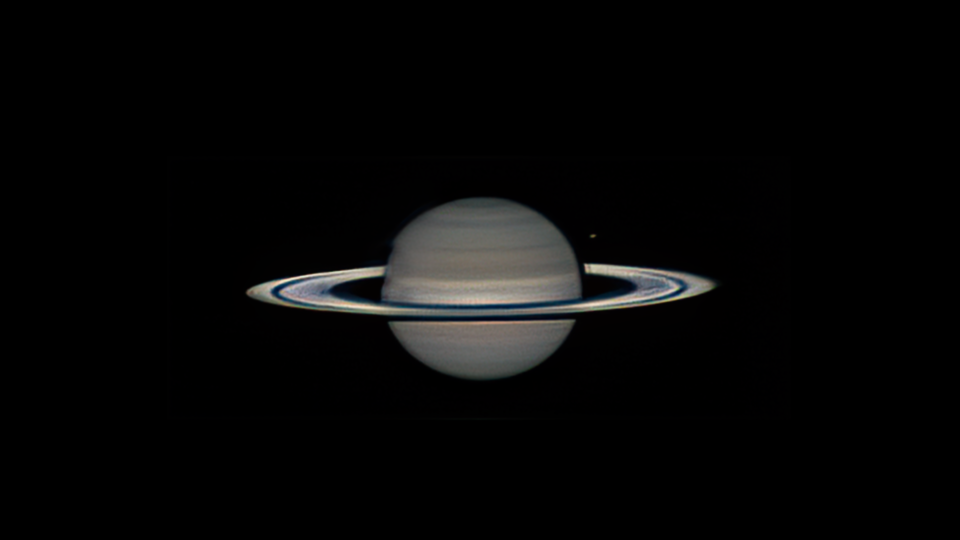

October 18 · 11:01–11:43 PM EDT
14 captures, including the dimmer slit-obstruction interval.
Choose a capture, then compare its best processing presets with another image. Default lists are deliberately short; complete archived experiments remain one tap away.
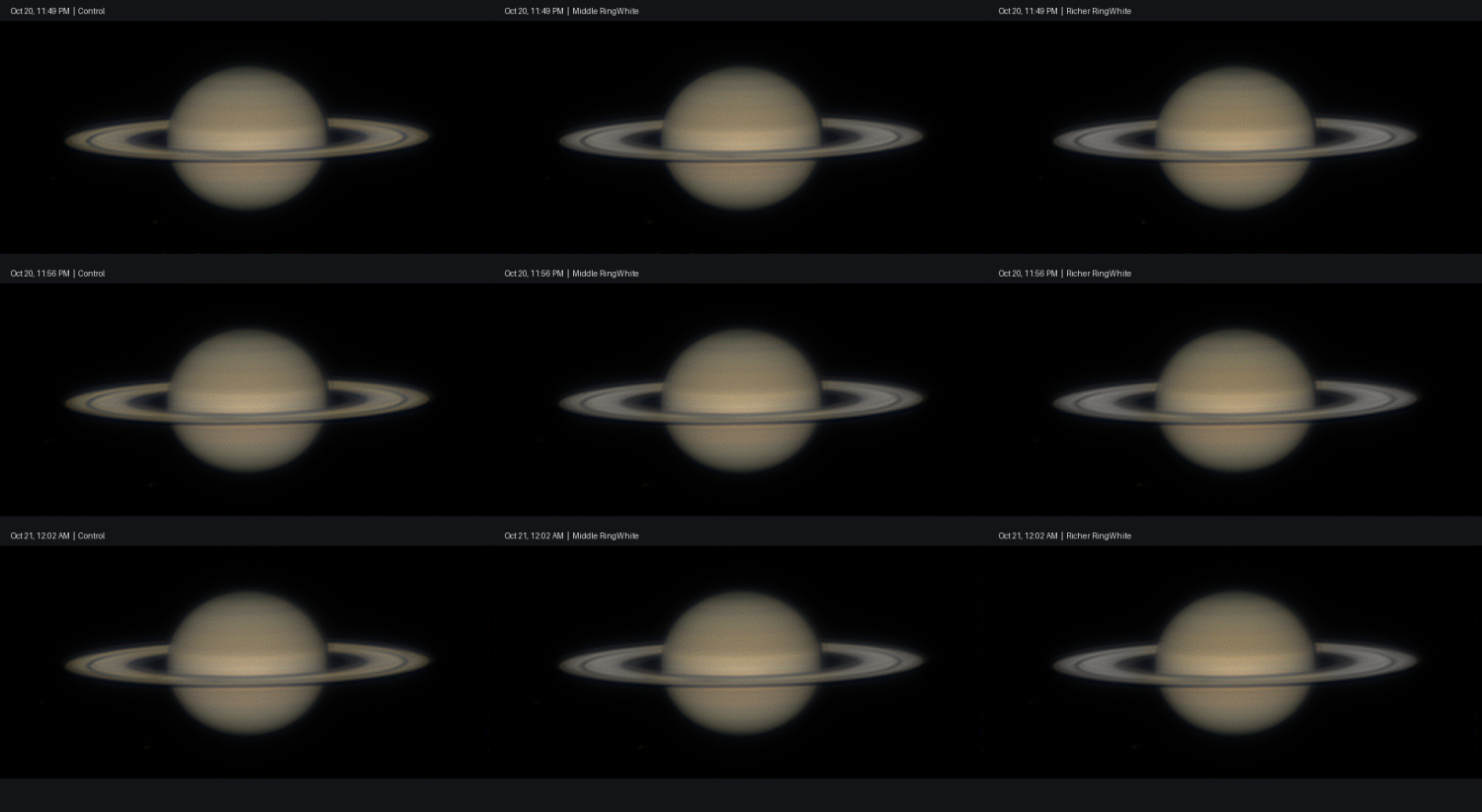
New 10% native AutoStakkert!4 stacks captured October 20 at 11:49 PM and 11:56 PM, and October 21 at 12:02 AM Eastern. These were the best complete-ring recordings selected from 52 SER files. Seeing was unusually poor, with upper-level haze and smoke; the results are intentionally conservative. Each capture includes the unsharpened native stack, RegiStax 6 Control, Middle RingWhite and Richer RingWhite. These October 20 versions have not been run through Topaz.
Open all three captures and their three RegiStax color treatments at equal image scale. Use the left and right dropdowns below to switch between October 20 captures and other nights. Direct links to PNGs and original 16-bit TIFF files are provided for each preset.
Inspect the original 180-second planetary capture and compare the upper-left edge of Saturn with the processed 11:04 PM frame in the moon animation. This is an unstacked, unsharpened video: no RegiStax wavelets, Topaz, contrast boost, moon enhancement, or frame alignment. What you see is the actual atmospheric turbulence and camera signal after ordinary Bayer-to-color conversion.
Original ASI224MC SER: 21,751 frames, 416 × 182 RAW8 pixels, captured 11:02:52–11:05:52 PM EDT. Converted to a 180-second H.264 MP4 at 60 fps (evenly sampled from approximately 121 fps), displayed at 832 × 364 by 2× nearest-neighbor scaling. No extra detail or missing ring shape has been generated. A faint discontinuity that appears only after RegiStax/Topaz is a processing artifact, not a feature in the SER.
True 10% AutoStakkert! 4 stacks with 1.5× drizzle, native RegiStax and punchy full Topaz Clear (Medium/High/Recover 10). No blue boost. Saturn is aligned to a fixed center between recordings; the faint moon is selectively brightened only where independently recorded pixels support its position. No interpolated moon positions or synthetic video frames.
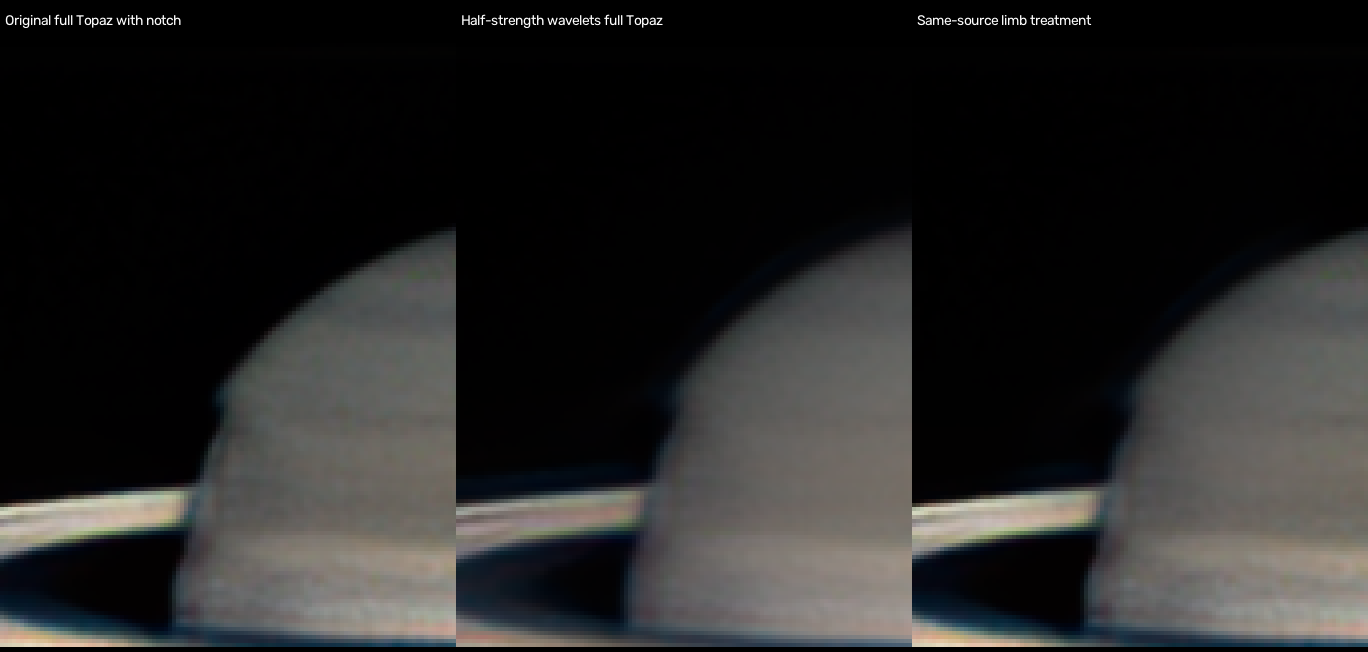
20 authentic capture timestamps, October 19 at 10:47 PM to October 20 at 12:06 AM EDT. October 19 at 11:04 PM was fixed using a newly calculated AutoStakkert 10% stack (1.5x drizzle) from the original 11:04 SER, then authentic RegiStax at half our usual wavelet strength and the same full native Topaz Clear pass. The entire 11:04 planetary image was replaced with the newly restacked, gentler full-Topaz frame; none of the previously over-sharpened limb is reused. No pixels were borrowed from 11:01 or 11:07. This one animation frame is intentionally a little softer to protect the globe limb. The true 11:04 source SER is also preserved and viewable separately. One corrupted capture around 11:20 PM was excluded. The recordings after 12:06 AM are too clipped at the ROI boundary for a complete Saturn image.
Compare original 11:04 vs softer reprocessed limb | View corrected 11:04 image | 16-bit TIFF master | Original unprocessed 11:04 SER video
Best 10% stacks · full Topaz · no blue boost. Saturn was re-centered to subpixel accuracy between captures (October 20 correction); Dione is independently stacked from recorded frames and brightened. Relative moon brightness is altered. Playback holds each recorded capture without generating intermediate positions.
14 captures, including the dimmer slit-obstruction interval.
7 usable captures. Dione approaches the limb; the final two frames retain the recorded image without an extra moon enhancement because glare prevents a reliable separation. Fully black captures at 12:33 and 12:35 AM were excluded.
Independent genuine RegiStax -10% / -20% / -35% wavelet processing with the actual rings retained from each native output, alongside the unsharpened AS!4 reference. No original Gold Mid ring transplant, no AI sharpening or enhanced black point. Compare C ring visibility, shadow tone and tiny globe specks on the fixed-geometry draggable comparison page.
A genuine 16-bit color variation, exactly 45% of the way from Warm Golden Globe to Richer Gold v2, while preserving the original sharpening, brightness, globe bands and punchy white rings. All three color treatments are shown at identical 1:1 source pixel scale, without resizing or brightness normalization. The original punchy processing is also retained in the Lab's ten curated presets for this capture.

The optional blue +10% control has been retired from the interactive Lab. Its older files are preserved, not deleted. The ten main presets for October 18 at 11:01 PM now emphasize the color profiles and useful sharpening/Dione comparisons.
An optional warmer globe profile inspired by Ethan Chappel's warm Saturn coloration; preserves our crisp white rings and the authentic AS!4 10% / RegiStax / full Topaz image. This is a color-finishing test, not a change in seeing, camera or stack. The previous punchy masters remain intact and selectable.

Top: October 19, 11:50 PM. Bottom: October 18, 11:01 PM. Left current punchy, right warm golden trial. Select the same named profile under each capture below for full-size or TIFF.
Both Richer Gold v2 images are presented at one source image pixel per comparison pixel, centered at the same point, with brightness matched from the upper globe. Original October 18 was about 6.4% brighter in that region, so only its overall brightness was lowered to match October 19. No colors or original TIFF/PNG masters were changed. The rings measure 470 and 475 source pixels across (roughly a 1% difference in the original recordings).

The interactive viewer below now defaults to comparing the two v2 images with Match Saturn size and center enabled. That option normalizes Saturn's measured ring diameter (470 display pixels) across the 192 listed processing presets, regardless of the camera ROI, and aligns Saturn's center. Disable the checkbox to see the full original capture framing. This rescales only the viewer, never the original image files. Across different years or optical configurations it is a visual comparison, not a calibrated arcseconds-per-pixel measurement.
All three featured October 19 captures (11:14, 11:50, and 11:53 PM) have Original Punchy, Warm Golden Globe and Richer Gold v2 available. Each capture keeps its own curated 3–8 processing choices, including the original unsharpened stack. Change captures independently to compare different nights or stack percentages.
Genuine RegiStax -10% wavelets plus our Gold Mid-style color balance and conventional denoising. No new AI sharpening, and unlike the previous -10% hybrid, no inherited original Topaz rings or crushed C-ring/black-point treatment. Drag between the original, prior -10% and new full -10% natural-ring version.
Select any pair below, then drag the white divider across the same-size image. All three remain available independently in both processing-preset drop-downs above. The original has its full Topaz finish; −10%/−20% are true native RegiStax reruns with Gold Mid-style no-new-Topaz globe finishing and untouched original rings.
Bright-band 3× crop · All three full frames · −10% RegiStax preset
Our October 7 punchy version remains the color reference; the 90% Topaz blend is a subtle less-processed alternative. The October 18 1:59 AM 20% Topaz + ring-white RGB balance trial is marked as the current preferred October 18 option, pending visual selection.
October 18: all 51 SERs sampled over their duration; 26 were eligible 180-second centered captures. The 1:59 AM, 2:15 AM, and 2:12 AM videos were fully evaluated by AutoStakkert 4 and stacked best 10%, 1.5× drizzle. The pre-Topaz control used genuine RegiStax Softer10 native wavelets, saved RGB gains and 24% median denoise. The ring-whitening trials measured and applied a further, limited channel balance in the outer rings; previous gain was not applied twice.
The lighter October 7 options blend the actual Topaz master TIFF with the genuine pre-Topaz control in a 90/10, 80/20, or 65/35 ratio; they are not independently rerun Topaz models. Preserve the original Oct 7 white-ring appearance and ring detail as your preferred reference.
Topaz Clear in this lab means Medium noise reduction / High sharpening / Recover Detail 10 / Color Noise Reduction 0. Some historical capture presets use alternative RegiStax / AstroSurface / Nik/Levels; names identify them. Treat available TIFF masters as sources of truth; browser previews are 8-bit. All original SER captures and older masters are preserved.
October 18 full capture information · RGB and ring white recipe · October 7 recipe
The two 180-second videos show substantial Saturn ROI drift, including clipping. Strict 10px screening found only about 5.6–5.8% centered frames. On the server, a custom Python frame-registration stacker selected the best 250 of those sampled safe frames, with the alternatives using all 641–642 eligible sampled frames. Eight available comparison choices per recording are clearly labeled as conventional, non-AI, and processed with 1.5x interpolation—not native AutoStakkert drizzle, RegiStax, or Topaz. Ring RGB balance was calibrated for this session, not inherited blindly from Oct 13. These are experimental previews, not new favorites.
Four new groups are from actual AutoStakkert 4 1.5× drizzle (10% or 17%), true native RegiStax Softer10, and native Topaz Clear Medium/High Recover Detail 10. The new 20%, 50%, 90%, and 100% processing choices blend the genuine native Topaz result with its pre-Topaz source, rather than simulating Topaz. The additional white-ring RGB/channel balancing is reproducible 16-bit numerical finishing. The original unsharpened AS4 TIFF remains a selectable reference. Tracking drift reduced ideal frame coverage, but these are full native stacks rather than the earlier strict-sample Python tests.
Nothing was deleted or merged. The legacy Processing Lab retains the full historical controls, tracking audits, multiple per-image processing schemes and research notes.
Open full original Processing Lab · Open full Oct 18 legacy comparison · Open full Oct 9 experimental comparison


