Image quality: The session was less sharp than our October 7/18 references. Saturn remained safely inside the ROI in 25 recordings; the 12:13 AM capture lost it partway, and all 27 later recordings from 12:17 to 1:47 AM contain no detectable Saturn. These aren't included in the final selections.
REV2 - fully processed 26-frame Saturn + Rhea / Dione (no early blinking)
All 26 frames now have genuine native AutoStakkert 4 best-10% 1.5x drizzled planetary source images. Every frame is individually finished to the Gold Mid or Gold Mid gentler profile, with wavelet-style detail, consistent color/RGB balancing and gentle denoising before measured Rhea and Dione moon signals are enhanced. The three 12:03, 12:07 and 12:10 AM reference images retain their genuine native RegiStax 6 masters; the other 23 use a pixel-by-pixel calibrated multiscale finish trained on those genuine reference masters (they are not falsely labeled as RegiStax or Topaz exports). The actual planet is registered to remain steady, and both moons move according to the actual recordings. No single Saturn frame is reused as a static backdrop.
These corrected video exports replace the earlier versions that were visibly underprocessed. Original SER data, 26 native AS4 stacks and 26 individual fully finished 16-bit animation-frame masters are preserved on the server.
REV2 FIX: Dione now stays visible after it enters the camera's actual recorded field. Its early dim frames use real nearby time-sequenced moon observations, aligned along measured motion. Saturn, Rhea, all other pixels, and all 26 wavelet/denoising finishes are unchanged. The first two recordings are unaltered because Dione was physically outside the recorded ROI.
Animation spans October 22 10:44 PM to October 23 12:10 AM EDT. Timings are compressed for playback, not a continuous real-time video.
The slight output-sharpening third choice uses a reproducible edge-guarded filter. I did launch Nik 9 Sharpener Output on the server, but its GUI failed to render; this choice is NOT a genuine Nik export. The prior six-frame real-planet trial is retained for reference.
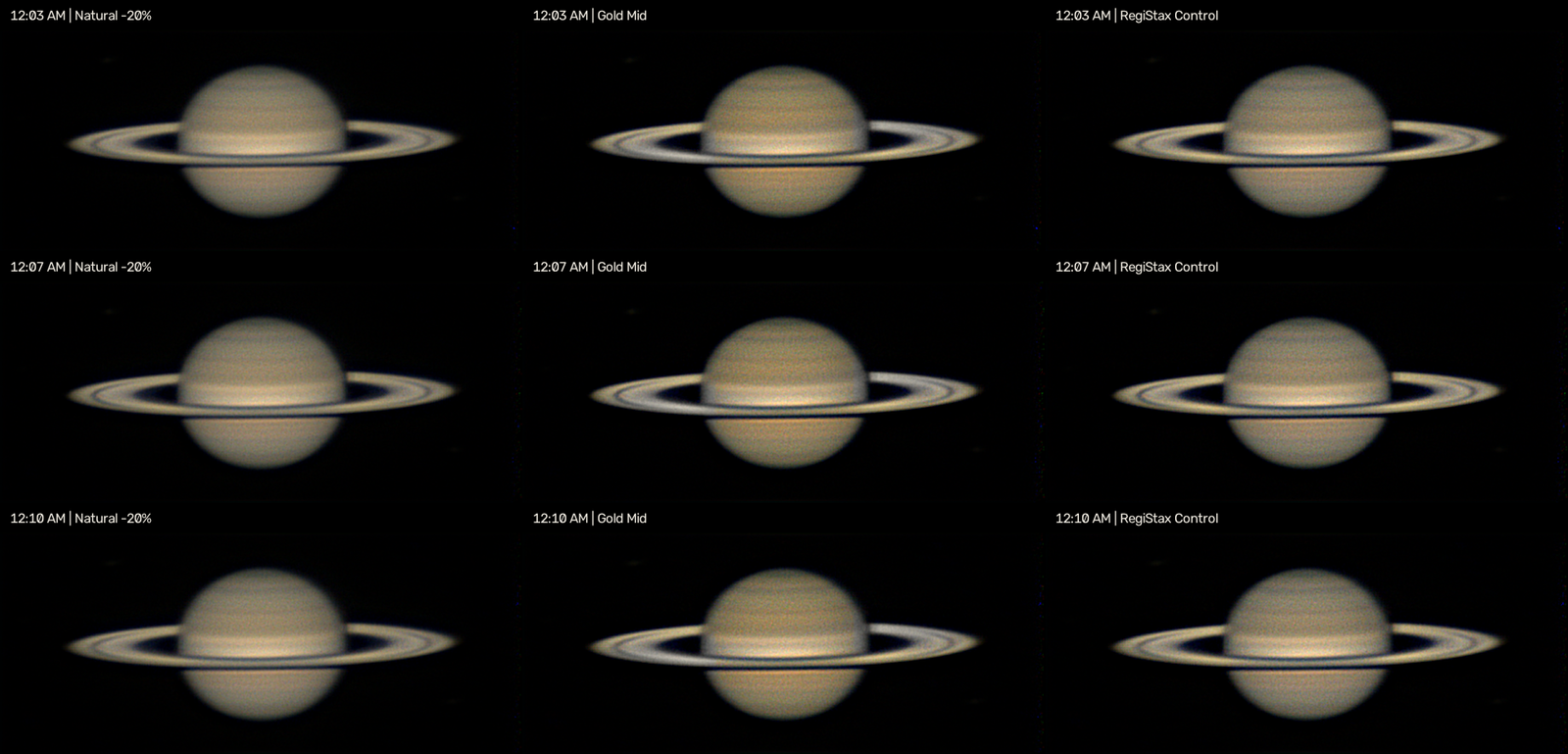
Best-three contact sheet
Side-by-side RegiStax Natural −20%, Gold Mid, and Control, displayed at matching original 624 × 264 pixel dimensions.
Preserving the gray C ring without over-sharpening
The original Gold Mid looks attractive but begins with the stronger RegiStax Control wavelets, which can expose speckled seeing noise. The new Gold Mid -20% uses genuine lower-wavelet RegiStax data and carries across the Gold Mid color adjustment. The new Gold Mid -20% + gentle denoise also smooths weak luminance and chroma variation, with strong ring edges protected. Neither version deliberately whitens the translucent gray C ring. Compare current Gold Mid (left) against smoother Gold Mid (right).
AS!4: planet COG, 10% and 5% lucky frames, Noise Robust 6, Local AP (59 points), RGB align, 70% normalized, 1.5× drizzle. RegiStax: real original Control plus −20%/−35% wavelet profiles; native 16-bit TIFF masters preserved. Gold/Warm/Richer and White Rings are color finishing passes on real RegiStax Control data. One additional tenth choice uses genuine Topaz DeNoise AI 3.7.2 (Clear / Medium noise / High sharpness / Recover 10) on native RegiStax −20%; the other nine choices do not use Topaz, so the older native Topaz Clear Medium/High/Recover 10 reference should not be confused with this new Gold Mid Color option.